by: Jessica Chen S.E.
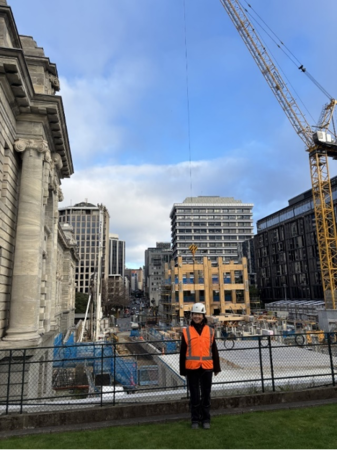 Conference Site Tour of the Parliament Buildings
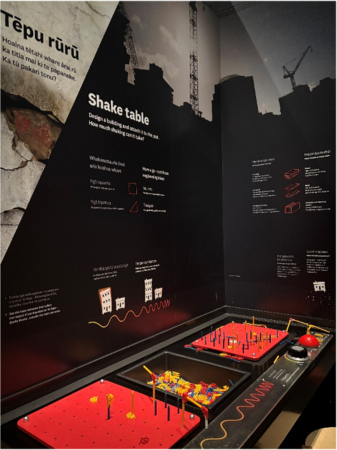 Earthquake Exhibition at Te Papa Museum
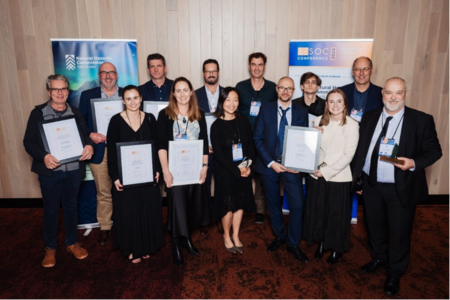 Award Winners Group Photo from the SESOC Gala & Awards Dinner
I attended the SESOC 2025 Conference in Wellington, New Zealand, as the winner of this year's travel scholarship, funded by SEAOC member contributions through the SEAOC Foundation. The conference was held in the country’s capital city of Wellington and was my first conference experience outside of the United States.
Laura Whitehurst, project director at Holmes Wellington and a member of the SESOC-SEAOC Collaboration Committee, whom I knew when we both worked at Walter P. Moore in California, kindly gave me a tour of her project for the new Parliament buildings. The 2 new buildings and associated infrastructure are developed to house Members of Parliament and staff, ensuring a secure parliamentary precinct which reflects the country’s heritage and culture. Besides the project's significant cultural and political influence, the buildings employ a series of innovative structural strategies that are not commonly seen in the US. The buildings use lateral systems of timber braced frames and timber moment frames and are base-isolated with supplementary damping. It was impressive seeing such a unicorn of structural design as part of my conference experience.
Among the conference program, I was fascinated to learn about the technical standards updates in New Zealand in one of the keynotes. Different from ASCE 7, New Zealand’s TS1170.5 is more focused on ductility and capacity design, especially after the 2011 Christchurch earthquake. ASCE 7, on the other hand, integrates a broader range of seismicity and relies on tabulated R-factors with less direct emphasis on ductility. There were also project showcases from Kiwi engineers that addressed unique challenges that projects in the US may not encounter, like the country’s highly liquefiable soil condition, and designing precast foundations for an energy project on a remote island in the Pacific Ocean.
I received a warm welcome from the entire SESOC community, including SESOC Executive Officer John Snook, SESOC President Stuart Oliver, SESOC Vice President Tessa Beetham, and other members of the SESOC Conference Committee. I also connected with Henry Rowden, the SESOC Emerging Structural Engineer (ESE) Committee chair, and Libby Lindsay, the SESOC ESE Traveling Scholarship Winner, who attended the SEAOC Conference in San Diego in September. Emerging Structural Engineer Committee is the New Zealand equivalent of Young Member Group. Having served as the NCSEA Young Member Support Committee chair myself, it was great to meet other young member leaders outside of the US. In the Emerging Structural Engineers sessions, I presented How to Engage Young Members at a Local and National Level Successfully, sharing experiences from Young Member Group leaders in the US.
The conference location was across the street from the Museum of New Zealand Te Papa Tongarewa, one of the major museums in the country, showcasing New Zealand’s culture and history. I visited it in between the conference sessions. It was cool when I found out that there was a dedicated exhibition about earthquakes, and even a shake table for the children to build structures with sticks to understand the basic principles of seismic structural design. It’s great to see how the country pays attention to building an earthquake-resilient community on a societal level.